Debate
Sponsor: Arrow Global Portugal | Vanguard Properties
The residential market is changing. New mobility patterns, different life stages and growing demand for flexible housing solutions are transforming the way people live, work and use cities.
Between homeownership and traditional renting, models such as coliving, build-to-rent, serviced residences and flex living are emerging to address increasingly diverse needs. But is this a structural transformation of the real estate market or simply a trend? And can flex living help diversify Portugal’s housing supply without adding further pressure to the residential market?
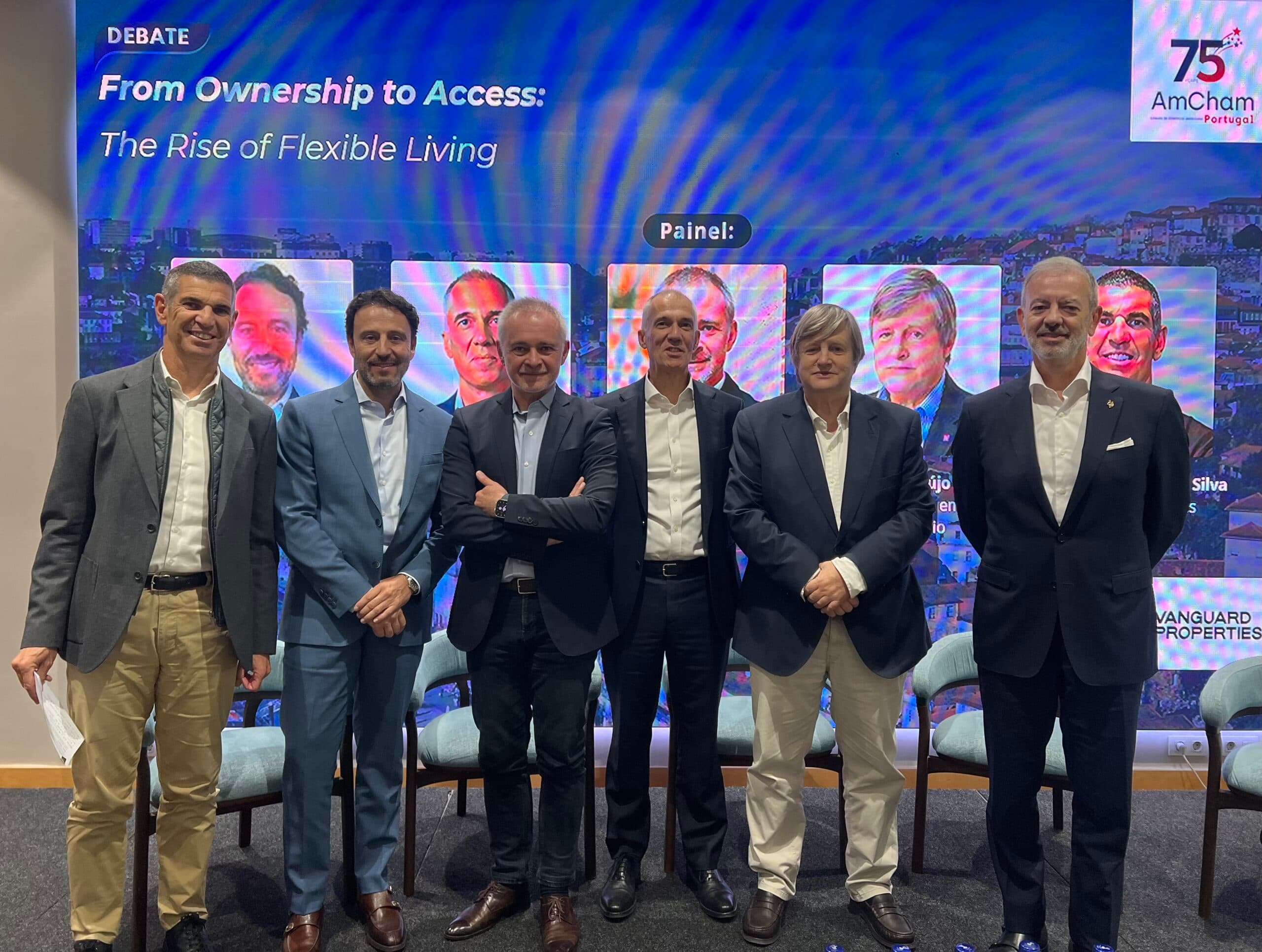
These were some of the questions explored at the meeting “From Ownership to Access: The Rise of Flexible Living”, organised by AmCham Portugal in collaboration with its Real Estate Committee.
A new way of living and using spaces
In his opening remarks, João Bugalho, Chair of AmCham Portugal’s Real Estate Committee and Chief Country Officer at Arrow Global Portugal, highlighted the transformation of housing and mobility patterns.
More frequent relocations between cities and countries, professional mobility and changing life stages are creating needs that traditional residential supply does not always address.
Students, international professionals, people relocating between cities, families at different stages of life and other segments are looking for solutions that offer greater flexibility in length of stay, ease of move-in and move-out, and access to services and shared spaces.
In this context, flex living is emerging as an alternative between homeownership and conventional renting. It is not intended to replace traditional housing models, but rather to add diversity to the market by addressing needs that existing formats do not always accommodate.
From housing to experience: the role of operations and services
One of the key changes identified during the discussion was the growing importance of operational management in real estate investment.
While the assessment of residential assets has traditionally focused on factors such as location, price, architecture and construction quality, new flex living models introduce additional dimensions: services, technology, shared spaces, user experience and a sense of community.
The value of a project increasingly depends not only on the building itself, but also on how it is managed and the experience it provides to residents.
Shared spaces, integrated services and opportunities for interaction can be particularly relevant for those arriving in a new city and seeking a housing experience that goes beyond the provision of private space.
This brings some flex living models closer to hospitality, while maintaining a residential proposition and a different relationship with space, length of stay and community.
An investment opportunity in a changing market
The discussion also explored the evolution of the Spanish market, where flex living has been gaining scale and attracting institutional investors and specialised operators.
The Spanish experience demonstrates the potential for this category to develop, while also highlighting the importance of understanding its different components. Flex living is not a homogeneous product: it can take different forms, target different audiences and involve different operating models and investment structures.
The potential for converting existing buildings was also discussed, particularly office assets and other properties that could find alternative uses. This could provide an opportunity to revitalise underutilised assets and develop new housing formats, provided urban planning, technical and regulatory requirements are met.
Portugal: growth potential and regulatory challenges
In Portugal, the discussion identified opportunities for the development of this segment, alongside several challenges that need to be addressed.
The lack of greater regulatory clarity regarding different flex living models, their interaction with rental legislation, building use regulations and licensing processes can create uncertainty for developers, operators and investors.
This is particularly relevant for projects involving the conversion of existing buildings, where changes in use may require specific adaptations and administrative decisions.
Regulatory predictability and a clear understanding of the risks associated with these assets will be essential to attract financing and support the sustainable development of the market.
Flex Living and the housing crisis: complementarity, not replacement
The housing market faces a structural shortage of supply, requiring a broad range of solutions, including more construction and greater capacity to deliver housing.
In this context, flex living should not be seen as a standalone solution to the housing crisis. Its current scale and the type of demand it addresses mean it cannot replace a broader strategy to increase residential supply.
Its potential lies primarily in diversification: creating alternatives for specific population segments, bringing underutilised assets back into use and addressing mobility and temporary accommodation needs.
The meeting concluded with a reflection on the future of Portugal’s real estate market and the potential of new housing models to respond to evolving demand patterns.
Flex living could represent an opportunity to diversify the market, attract investment and unlock new uses for certain real estate assets. Its long-term development will, however, depend on establishing an appropriate regulatory framework, ensuring economic viability and maintaining complementarity with existing housing supply.
AmCham Portugal would like to thank João Bugalho, Alejandro Zugasti, André David Nunes, Hakan Kodal, José Araújo and Henrique Rodrigues da Silva for their participation and valuable contributions to this discussion on the evolution of the real estate market and the opportunities for Portugal.
Program
09h00 | Welcome coffee
09h10 | Welcome Remarks – State of the market – João Bugalho, Chair of AmCham Portugal’s Real Estate Committee & Chief Country Officer of Arrow Global Portugal
09h25 | Panel – Are we witnessing a permanent shift in how people live and use cities, or just a post-pandemic adjustment?
10h10 | Q&A
10h25 | Closing and networking coffee
Event organized in collaboration with AmCham’s Real Estate Committee.
Members are the first to receive invitations and full programs.
Become a member