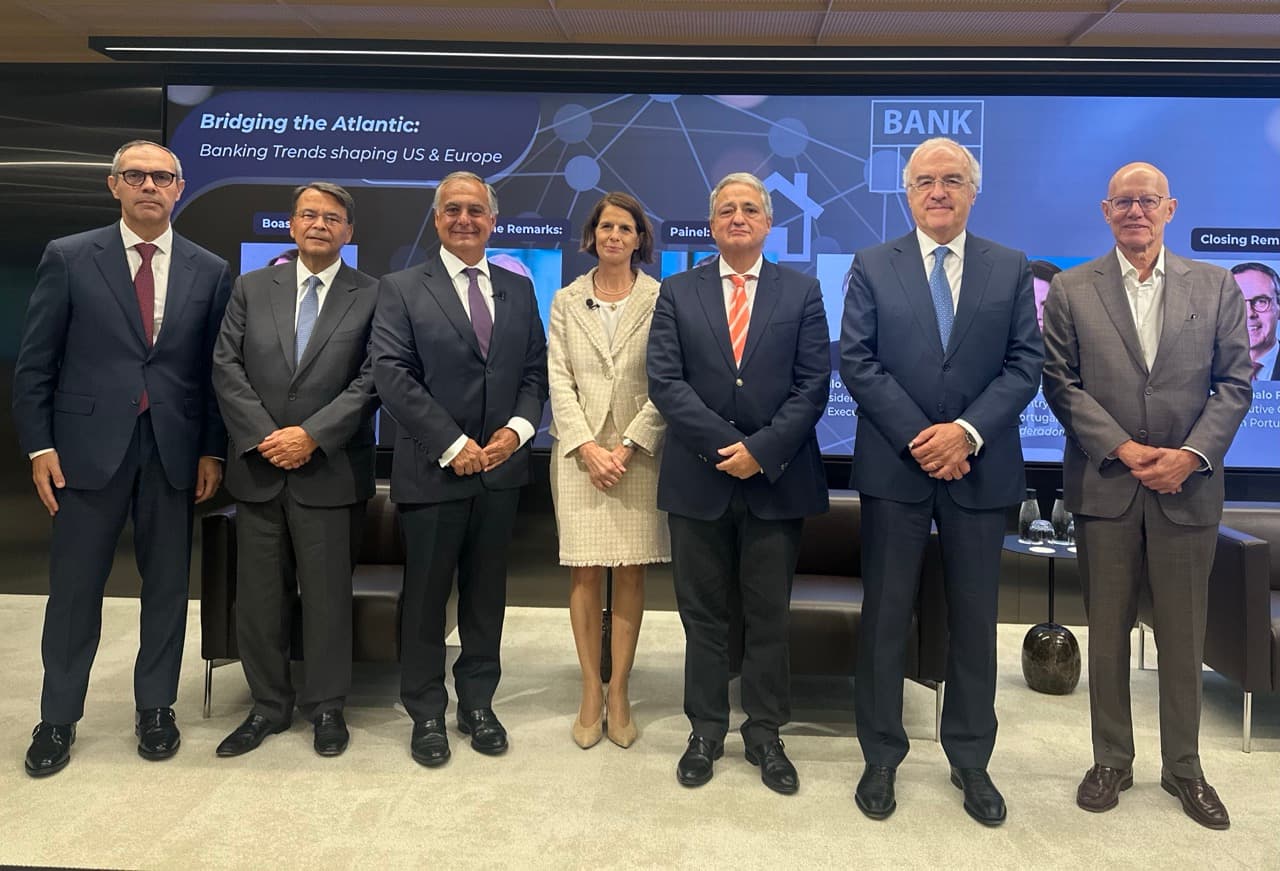
Bridging the Atlantic: Banking Trends Shaping US & Europe
September 22, 2026 | 08h45 – 10h45
Sponsor: AON | Support: Cuatrecasas
AmCham Portugal, in collaboration with its Financial Services Committee, hosted the session “Bridging the Atlantic: Banking Trends Shaping US & Europe”, devoted to the main challenges transforming the banking sector in the United States, in Europe and in Portugal.
In a context marked by accelerating technology, evolving payment systems, rising cybersecurity risks and an increasingly complex regulatory framework, the meeting offered a reflection on the financial sector’s ability to adapt and on the balance between innovation, resilience and competitiveness.
The session opened with welcome remarks by Luís Miguel Cortes Martins, Senior Partner at Cuatrecasas, and António Martins da Costa, President of AmCham Portugal, followed by a panel moderated by Leslie Rubio, Citi Country Officer Portugal, with João Pedro Oliveira e Costa, CEO of Banco BPI, and Paulo Moita de Macedo, CEO of Caixa Geral de Depósitos.
Key takeaways from the session
Financial innovation brings new opportunities, but also new risks
Digital transformation is rapidly changing the way customers interact with banks, make payments and access financial services.
The rise of instant transfers, digital wallets, deposit tokenization and AI is accelerating the transformation of the sector. At the same time, these developments raise new challenges in terms of security, fraud and protecting trust in the financial system.
During the debate, it was stressed that innovation must be accompanied by a careful assessment of its impacts, especially where infrastructure essential to the functioning of the economy is concerned.
Cybersecurity was identified as one of the main concerns for the banking sector. As the speed of transactions and the amount of data available increase, so do the opportunities to improve the services provided to customers, but so does exposure to new risks.
In this context, AI could play an important role, notably in the ability to analyze information and better understand customers’ needs, making it possible to develop increasingly personalized experiences and services.
The challenge lies in balancing innovation and resilience
One of the cross-cutting themes of the debate was the need to strike a balance between the speed of transformation and the robustness of the financial system.
Technological change is altering business models and bringing new players into the sector, but banks continue to play a central role in the stability and functioning of the economy.
The discussion therefore highlighted the importance of preserving the trust and resilience of the system while keeping pace with technological transformation.
As was summed up during the panel, “we are all in favor of innovation, but when we are touching the very essence of our society, we have to be very careful.”
Portugal still relies heavily on banks to finance the economy
Another central theme was the structural role of banks in financing the Portuguese economy.
In the case of Caixa Geral de Depósitos, around 95% of total funding comes from deposits, reflecting the importance of this funding base for the bank’s activity.
The debate also highlighted that companies have different sources of financing – from bank lending and debt markets to private equity and venture capital – but that in Portugal these alternatives are not as deep as in other markets.
In this context, it was pointed out that “banks fill these four market gaps”, reinforcing the role of banks in financing companies and projects of different sizes.
The relationship with customers is also changing. As was noted during the session, customers no longer just compare deposits with one another, but different financial investments, taking into account risk and potential return.
The US and Europe have structurally different financial models
The comparison between the two sides of the Atlantic was at the heart of the conversation.
In the United States, capital markets and investment banking play a much more significant role in financing the economy, while in Europe traditional banking still carries significantly more weight.
This difference is also reflected in customer behavior, in companies’ sources of financing and in the level of competition between different financial players.
In the American market, greater investor participation in capital markets creates a more diversified financing structure, whereas in Portugal and in many European markets deposits and bank lending continue to occupy a central position.
The debate thus highlighted the importance of analyzing the competitiveness of European banks not only in the light of the European Union’s internal reality, but also taking into account competition with major global financial markets, notably the United States and China.
Simplifying regulation without compromising stability
Regulation was another central theme of the discussion.
The participants recognized the importance of a robust regulatory framework to ensure stability and trust in the financial system, but also warned of the risks associated with regulatory complexity and fragmentation.
In the European context, the existence of different levels and structures of supervision can limit banks’ agility and create obstacles to their ability to compete in a global financial market.
The challenge, therefore, is to strike a balance between regulatory robustness and competitiveness, identifying the areas where simplification could have the greatest impact.
As was argued during the panel, it will not be necessary to transform the whole system at once: it will be important to identify the main obstacles and act progressively on those that most constrain the economy’s capacity for investment and financing.
Among these issues, capital was identified as a particularly relevant one, given its impact on banks’ ability to lend and support investment.
Strong banks are essential for a resilient economy
Throughout the session, the role of banks beyond their traditional function of financial intermediation was also emphasized.
Banks play an important role in financing housing, companies and the economy as a whole, and have also shown their importance as essential infrastructure during times of crisis.
The experience of the pandemic was cited as an example of the importance of ensuring the continuity of the banking system at times of great uncertainty, alongside other services essential to society.
In this sense, the discussion concluded that the future of the financial sector will depend on the ability to combine innovation, security, scale, financing and efficient regulation, while maintaining the trust on which the financial system rests.
AmCham Portugal thanks the speakers João Pedro Oliveira e Costa, CEO of Banco BPI, and Paulo Moita de Macedo, CEO of Caixa Geral de Depósitos, as well as the moderator Leslie Rubio, Citi Country Officer Portugal, for taking part and for the valuable insights shared during the session.