Speech by the Secretary of State for the Economy, João Rui Ferreira
The Secretary of State began his speech by stressing the need to look first at the current reality before projecting the future, highlighting the economic impact of the recent extreme weather events and the destruction in the Centro region of the country. He said these were events impossible to control, but which require swift and coordinated responses for the population and for companies.
Among the priority measures, he highlighted:
– Preserving value chains and quickly making financial support available to the companies affected, with around €500 million estimated in immediate support;
– The role of insurers, praising their commitment and responsiveness;
– The need to start the reconstruction phase right away, under the “Build Back Better” principle.
At the structural level, he stressed that Portugal has been posting positive economic indicators:
– Economic growth above the European average in 2025 (c. 1.9%);
– Around €3.5 billion of foreign direct investment attracted through AICEP;
– Good employment levels and rising average wages;
– Public debt down to around 89.7% of GDP.
He also pointed to the country’s main strategic assets: skilled human capital, a competitive energy sector, digital infrastructure and Portugal’s position as a tricontinental platform and Atlantic bridge.
As regards the relationship with the United States, he stressed that it is not a single market but a set of distinct markets, requiring business scale, proximity to the end customer and investment in brand. He highlighted the importance of the Portugal Brand and the contribution of tourism to its international standing.
Finally, he pointed out that economic growth will be decisive in improving the quality of life of the Portuguese and that transforming productivity will necessarily involve digitalization, Artificial Intelligence and building the capabilities of SMEs.
Presentation of the AmCham Barometer 2026 – “Expectations and Outlook for 2026”
The presentation of the results, led by José Bizarro Duarte (Partner, PwC), framed the global context as one marked by environmental, technological and geopolitical risks. Extreme weather events now emerge as the leading global risk, while economic and social risks persist at the national level.
Main findings of the Barometer:
– 51% of managers are optimistic about the Portuguese economy;
– 29% show greater confidence in the international economy;
– 78% of American companies in Portugal expect their turnover to grow in 2026;
– 65% plan to make new investments (higher than in 2024).
Main challenges identified
– At company level: competitiveness, attracting and retaining talent, and cybersecurity.
– At sector level: competitiveness, talent and regulatory complexity.
– At country level: bureaucracy and regulation, talent shortages and economic uncertainty.
Artificial Intelligence and innovation
– 94% of companies already invest in AI;
– More than half are at a development stage;
– Main risks: data security and privacy, and the legal framework.
– Adoption depends mainly on the availability of skilled talent, the formalization of internal processes and an organizational culture ready for change.
Sustainability and geostrategic context
– 82% of companies have already implemented a sustainability strategy;
– The global influence of the US remains a relevant factor in companies’ decision-making;
– Trade tariffs had little or no impact on most companies.
Also highlighted were the growing diversity and qualifications of the foreign workforce in Portugal, as well as the country’s increasing exposure to talent shortages, a trend expected to intensify by 2030, with soft skills becoming more highly valued.
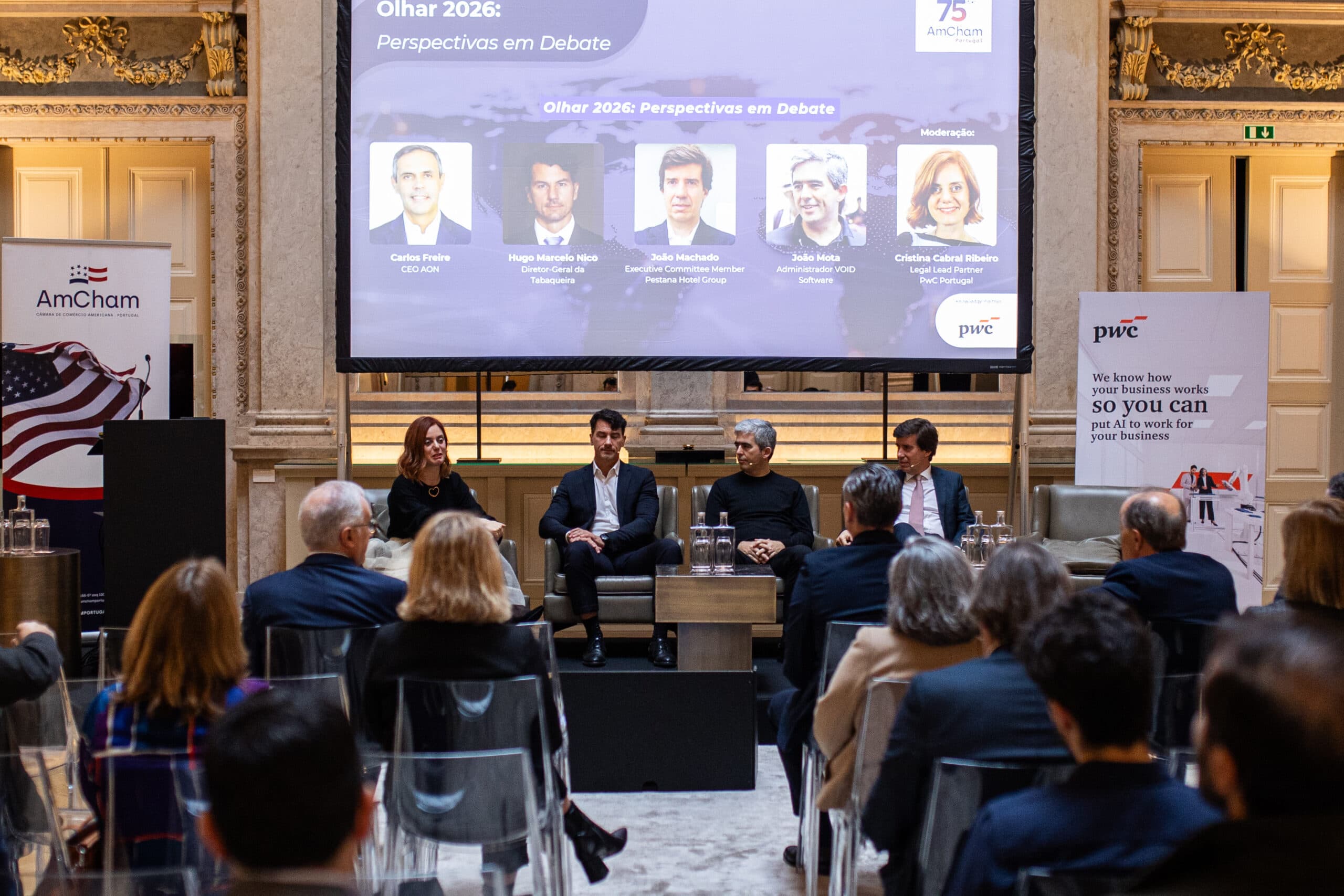
Panel Debate – Outlook for 2026
The panel brought together Carlos Freire (AON), João Mota (VOID Software), João Machado (Pestana Group) and Marcelo Nico (Tabaqueira), who shared the views of their respective sectors.
Carlos Freire, AON
He highlighted the direct link between measuring risk exposure and organizations’ ability to recover. He identified four major critical areas:
- Natural disasters and the need for new financing and risk transfer instruments;
- Global supply chains;
- The growth of data centers;
- The impact of Artificial Intelligence on risk models.
João Mota, VOID Software
He shared the company’s experience of expanding into the United States, pointing out that the American market more clearly values product and innovation. He stressed:
- the importance of being close to the customer to reduce the “friction of distance”;
- greater tolerance of risk and failure compared with the European context;
- the fact that the market is not deregulated, but rather less bureaucratic.
- The company has also become an investor in startups, currently with around 15 in its portfolio.
João Machado, Pestana Group
He recalled the contrast between 2019 (the best year ever) and the impact of the pandemic in 2020-2021. During that period, the group kept two priorities: preserving talent and investing in technology.
The direct online channel was decisive: sales through the website rose from around €19 million in 2019 to more than €100 million in 2025, with a positive impact on margins and profitability.
Marcelo Nico, Tabaqueira