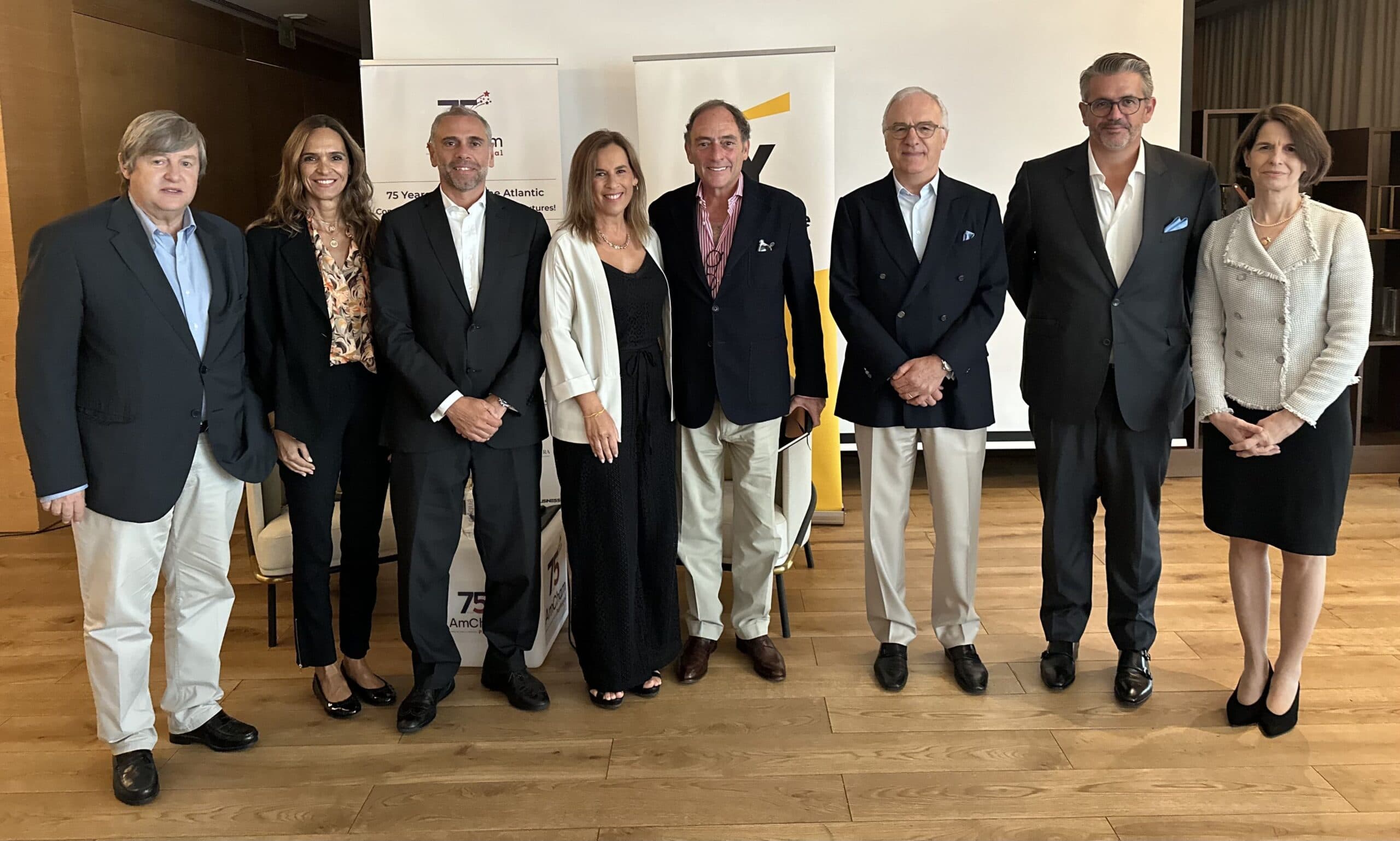
Part of AmCham Portugal’s 75th anniversary celebrations, this edition of the Transatlantic Conversations brought together business leaders to reflect on the main geopolitical and geoeconomic challenges shaping the relationship between Europe and the United States.
With Paulo Portas as keynote speaker and a fireside chat moderated by Miguel Farinha, Country Managing Partner at EY, the session provided a comprehensive analysis of the evolving international order and the impact of these changes on the economy, on companies and on strategic decisions.
At the very start of his speech, Paulo Portas offered a reflection that set the tone for the session: “We are faced with an obvious fact that few acknowledge.”
Starting from this idea, he guided the participants through an analysis of the main factors redefining the global balance and their implications for the economy, for companies and for the transatlantic relationship.
Key takeaways from the session
An increasingly multipolar world
Paulo Portas began by framing the transformation of the international order, arguing that the current context represents a structural shift in the distribution of global power. After a 20th century marked by the undisputed leadership of the United States, the 21st century is characterized by the rise of new centers of influence, particularly China, and by Russia’s strategic positioning.
In this new setting, understanding geopolitics has become indispensable for understanding the global economy and anticipating the trends that will influence markets in the coming years: “The 20th century was the golden century of the United States.”
The rise of China and the new center of global competition
China’s development took up a significant part of the speech. While acknowledging the country’s extraordinary economic growth over recent decades, Paulo Portas called for a balanced analysis, recalling that Beijing today faces significant structural challenges, notably in terms of demographics, productivity and its current model of governance.
At the same time, he stressed that it is above all in Asia, more than in Europe or the United States, that China’s rise is viewed with the greatest concern, especially given the growing tensions in the Indo-Pacific region: “Beijing causes a lot of anxiety in Washington, but it causes much more in Asia. It is we, in Europe, who do not realize it.”
Referring to the region’s future, he added: “CIA forecasts suggest that China will do something in Taiwan by 2027.”
Europe is still searching for its strategic position
Europe was also at the center of the reflection. Despite its economic size and the influence it continues to exert on international trade, Paulo Portas argued that the European Union still struggles to establish itself as a true geopolitical actor, as a result of the absence of a common defense policy and of greater strategic coordination among its Member States.
In this context, Brexit was also identified as one of the events that most weakened Europe’s position, depriving the European Union of one of its main strategic partners in its relationship with the United States: “Europe is a geoeconomic superpower, but it is not a geopolitical superpower.”
The United States: global leadership and domestic challenges
American politics was also in the spotlight. Paulo Portas analyzed the challenges the United States faces in maintaining its position of global leadership, in a particularly demanding political system marked by successive electoral cycles and growing political polarization.
He also addressed the impact of the midterm elections, arguing that the second half of the year could be relatively more stable from an international point of view, and shared some thoughts on the future of American politics: “The US is a particular kind of democracy. It is hard to maintain leadership when you have three elections in a four-year period.” “We should, in principle, have a quieter second half of the year.”
Looking ahead to the 2028 presidential elections, he added: “Let’s see which Republican distances himself from MAGA and which Democrat distances himself from wokeism. That could bring a new shine to America.”
The transatlantic relationship remains a strategic pillar
Despite the profound changes in the international order, Paulo Portas left a clear message about the importance of the link between Europe and the United States, which he considers remains one of the fundamental pillars of international stability.
He also pointed out that, despite the intense political debate surrounding NATO, support for the Atlantic Alliance remains very significant in the US Senate: “In the Senate, NATO has around 70% popularity.”
Companies, geopolitics and decision-making
This was followed by a fireside chat, moderated by Miguel Farinha, Country Managing Partner at EY, which made it possible to explore the impact of these changes on the business world in more depth.
Against a backdrop of growing international instability, the debate focused on how companies and investors should factor issues such as security, energy, supply chains, international trade, regulation and geopolitical risk into their strategic decisions. It became clear that understanding the evolving international context is no longer just an exercise in political analysis, but now plays a decisive role in organizations’ competitiveness and ability to adapt.
In this context, Paulo Portas also reflected on the different regulatory approaches on either side of the Atlantic: “Americans are tired of the excess of regulation in the European Union. However, they have already realized the challenges of zero regulation.”
The session ended with a question-and-answer session, giving the participants a valuable opportunity to explore some of the topics discussed in more depth and to reflect on the challenges that will shape the future of the international economy. As a final note, Paulo Portas delivered one of the most striking lines of the morning: “In the world we live in, those who make peace die, and those who make war get likes.”
AmCham Portugal thanks Paulo Portas, EY, Miguel Farinha and all the participants for contributing to another edition of the Transatlantic Conversations, reaffirming the Chamber’s commitment to fostering debate on the major issues shaping the future of the international economy and of relations between Portugal, Europe and the United States.
Members are the first to receive invitations and full programs.
Become a member