Business Perspectives
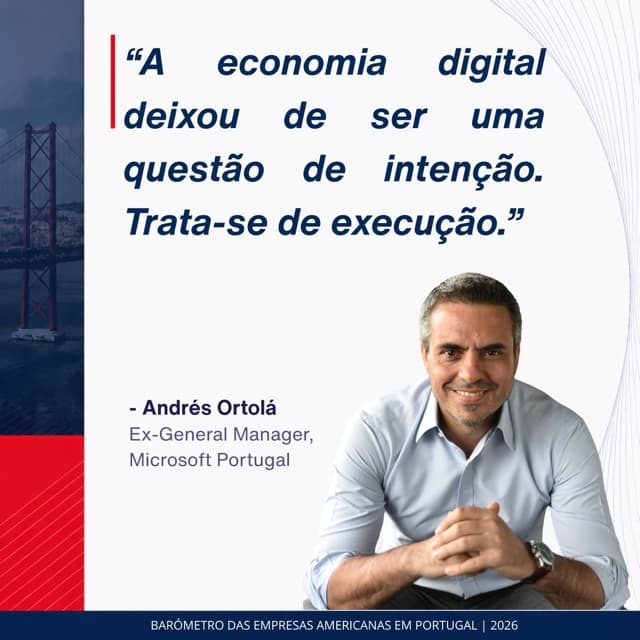
Andrés Ortolá
Former General Manager of Microsoft Portugal
The digital economy is no longer a matter of intention. It is about execution. Countries are no longer judged on ambition alone, but on their ability to turn technology adoption into sustainable economic results. Portugal is now at that point of transition.
The data is encouraging — and demanding. According to the AI Diffusion Report Q1 2026, 26.4% of Portugal’s working-age population already uses AI, an increase of 2.2 percentage points in a single quarter. Portugal ranks 20th in Europe and 36th globally, well above the global average of 17.8%. The momentum is real. Leadership, however, is still up for grabs.
This distinction matters. Experience across different markets shows that infrastructure is essential, but never enough. Portugal is strengthening its digital foundation through significant private investment in advanced cloud and AI capacity, including Microsoft’s long-term investment in Sines with partners such as Nscale. This places the country on the future map of AI infrastructure in Europe. Infrastructure alone, however, does not generate productivity, competitiveness or returns.
Those results only emerge when capacity is matched by skills at scale, modern data environments and organizations willing to rethink how work gets done.
Where this alignment exists, the impact is already visible. In sectors such as telecommunications, retail, energy, healthcare and manufacturing, AI is no longer confined to pilot projects. It is being used as an operational lever — accelerating software development, improving the customer experience, anticipating failures before they happen and reducing the administrative burden in clinical settings. These are operational gains, not experiments.
The ecosystem effect is significant. A recent study shows that Microsoft’s partner and customer ecosystem generates €7.3 billion a year, equivalent to 2.5% of Portugal’s GDP, supports 35,000 jobs and delivers a 9.6x return on investment. At full scale, that impact could reach €9 billion a year. Scale, once unlocked, multiplies.
There is also growing recognition, at institutional level, that Portugal is approaching a turning point. The signals around digital transformation, skills and responsible AI increasingly reflect an understanding that clarity, predictability and consistency will be decisive for competitiveness. At this stage, direction matters as much as pace.
Taken together, these factors point to a market with growing momentum and clear potential to scale. The next phase will be defined by how effectively adoption is translated into competitive advantage — and by how quickly organizations accelerate execution to place Portugal among the front-runners.
The digital economy rewards speed, depth and consistency. The window is open. Momentum, capacity and intent are converging — creating a real opportunity to act and shape the outcome.

AmCham Portugal
Founded in 1951, AmCham Portugal is a private, independent, non-profit business association — the largest bilateral association between Portugal and the United States.